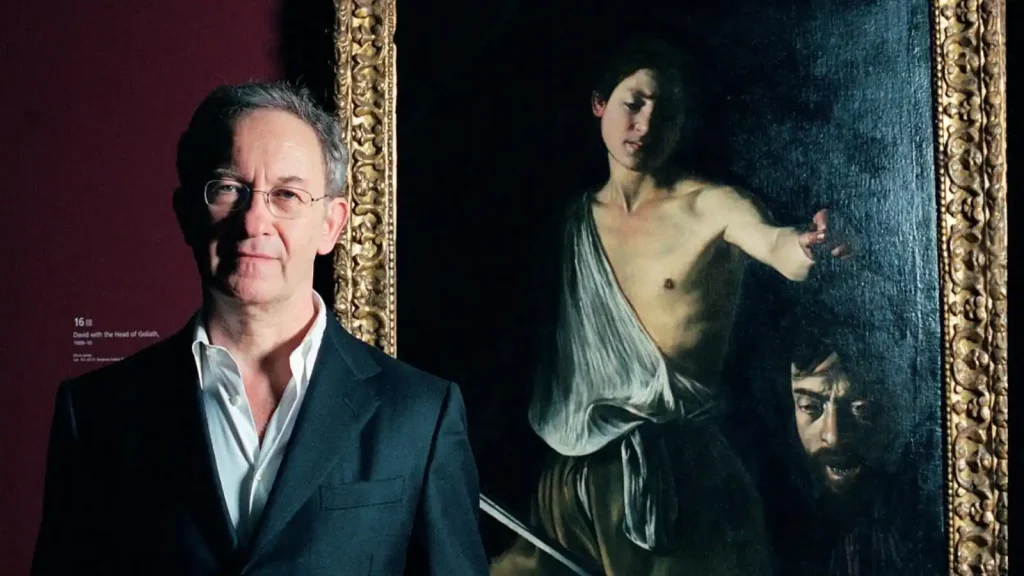
Simon Schama’s Power of Art episode 1 – Caravaggio delves into the tumultuous life and revolutionary work of Michelangelo Merisi da Caravaggio, an artist perpetually on the run, even in death. Born in a small Lombardy town, his life was marked early by tragedy; plague claimed his father and grandfather when he was just five. This early brush with mortality perhaps foreshadowed a life lived “without hope, without fear,” the motto he and his companions embraced on the dangerous streets of Rome. He was a man of immense talent and equally immense flaws, a painter whose genius often manifested as villainy. His journey was a constant battle, not just with the law, but with the very conventions of art itself.
The backdrop for Caravaggio’s dramatic career was Rome at the turn of the 17th century, the epicentre of a vast propaganda war. The Catholic Church, besieged by the Protestant Reformation in Northern Europe, fought back with all its resources. While Protestants emphasized the “Word,” the printed Bible, as the primary guide for Christians and dismissed paintings as “filthy idols,” the Catholic Church saw images as essential tools. Paintings were the “heavy artillery” in the war for souls, especially crucial for reaching the millions who could not read. This climate demanded powerful, moving religious imagery, creating a fertile ground for an artist who could deliver a visceral impact.
Power of Art episode 1 – Caravaggio explores how this artist met, and often exceeded, these demands, albeit in ways that frequently courted controversy. The documentary examines how Caravaggio forged a new path, rejecting the idealized beauty of the Renaissance masters in favour of a raw, immediate realism drawn from the world around him. It traces his meteoric rise, his brushes with the law, his flight from murder charges, and his desperate attempts to paint his way back to grace. His story highlights the profound connection between a creator’s life and their creations, demonstrating how personal demons can fuel groundbreaking artistic visions.
Caravaggio arrived in Rome in 1593, equipped with talent but little patience for the established artistic training. He was told to draw ancient sculptures and copy the Old Masters like Raphael to learn ideal beauty. Instead, Caravaggio looked to the streets. He famously declared he needed no models beyond the ordinary people he encountered daily. This rejection of academic tradition was fundamental, shaping an approach that would alter the course of art history. He never drew, relying instead on his keen eye and direct engagement with his subjects, painting them as they were.
His early works, like Boy with a Basket of Fruit, showcased this novel approach, presenting an “awkwardness” far removed from refined Renaissance ideals. His self-portrait as a “sick Bacchus” further cemented his rebellious stance. Instead of a symbol of youth and beauty, he presented a “morning-after wreck,” a god made “all too human,” complete with greenish flesh, filthy fingernails, and overripe grapes. He turned even a simple Basket of Fruit into a “life-and-death drama,” challenging the very purpose of painting as a pursuit of mere beauty.
This edgy, challenging style inevitably caught the eye of discerning patrons, most notably Cardinal Francisco Mario del Monte. A significant player in the Roman art market, del Monte saw Card Sharps and was captivated by its vibrant action and the tangible presence of its characters. He bought the painting and offered Caravaggio lodging and support within his palazzo, a world filled with poets, musicians, and intellectuals. Yet, even within this sophisticated environment, Caravaggio’s work retained its intense, almost claustrophobic immediacy, as seen in The Musicians, designed to demolish the “safety barrier” between the viewer and the painted world. Simon Schama highlights how this directness became a hallmark of his power.
Power of Art episode 1 – Caravaggio
The Roman Revolution: Light, Shadow, and the Streets
Caravaggio’s move into Cardinal del Monte’s circle provided stability, but his true test came in 1599 with the commission for the Contarelli Chapel in the Church of St Luigi. This was his chance to create public art, to move the masses towards faith. The Martyrdom of Matthew initially proved difficult, as the commission called for traditional elements Caravaggio resisted. However, turning to The Calling of Matthew, he found his voice. He realised he could make the sacred tangible by grounding it in the squalor he knew.
He set The Calling of Matthew not in some idealized Holy Land, but in a dim Roman dive, populated by characters reminiscent of his Card Sharps. Into this scene step Christ and St. Peter, their presence almost unnoticed by some. Caravaggio masterfully uses light and shadow; Christ is partially obscured, focusing attention on his extended finger and the “bolt of radiance” that transforms Matthew the sinner into a disciple. This use of chiaroscuro, the dramatic interplay of intense light and deep shadow, became his signature. It wasn’t just a technique; it was a metaphor for spiritual revelation, a light too strong for the “spiritually short-sighted”.
He wanted viewers to feel they were witnessing a real event, not just looking at a painting. “Seeing is believing” was his mantra. With this breakthrough, he returned to The Martyrdom of Matthew and transformed it. He stripped away solemnity, presenting a “brutal assault in a backstreet”. The scene is chaotic, terrifying, glimpsed as if in mid-flight – and indeed, Caravaggio painted himself into the scene as a fleeing coward. At the centre, floodlit, is the naked assassin, making the sinner, not the saint, the “hub” of the action. This raw, unsettling approach was a triumph, cementing his reputation as Rome’s most exciting painter.
Faith, Flesh, and Fury: Caravaggio’s Art and Life Collide
Success, however, fueled the “other Caravaggio” – the violent, unpredictable man. His behaviour grew increasingly bizarre; he denied his own brother, wore fine clothes to tatters, and taught his dog to walk on its hind legs. He prowled the streets with his gang, armed and ready for trouble, often abusing rivals. This aggression, this “sweaty closeness,” inevitably spilled into his art, producing works of “shockingly moving results”. His painting of Doubting Thomas is almost unbearably physical, with Christ guiding Thomas’s finger deep into his wound, forcing belief through touch.
Despite his thuggish nature, Caravaggio took Christianity’s message with profound seriousness. He believed, as Christ taught, that the “wretched of the earth can be saved,” and he made them the subjects of his sacred dramas. The Conversion of St. Paul shows Paul scorched by revelation’s light, while The Crucifixion of St. Peter captures the “sheer weight” of guilt and martyrdom. His faith was “carnal”; his figures are trapped in flesh, even when divine, embodying the core Christian idea of God made man. He was an “evangelist for the unwashed,” presenting figures like the Madonna of Loreto as a local girl, greeted by pilgrims with “filthy feet”.
This unflinching realism, however, began to trouble some within the Church. The word “indecent” started to circulate. This likely contributed to a rival, Giovanni Baglione, receiving a prestigious commission instead of him. Vicious poems mocking Baglione soon appeared, leading to Caravaggio’s arrest for libel. Though released to house arrest, he quickly broke its terms, leading to further arrests and showcasing his contempt for authority. His explosive temper famously erupted over artichokes in a tavern.
This volatility reached a crisis point with The Death of the Virgin. Rejecting traditional depictions of Mary’s gentle ascent, he painted her truly dead – green, bloated, and rumoured to be modelled on a drowned prostitute. The Carmelite sisters who commissioned it gave it back, a bitter rejection marking a dark turn.
Exile and Atonement: Power of Art episode 1 – Caravaggio’s Final Years
Caravaggio’s life spiralled further into violence. An affair with a model named Lena led to a confrontation with a rival, Mariano Pasqualone, whom Caravaggio ambushed and attacked. By May 1606, he was a “homicide waiting to happen”. A dispute, possibly over a woman or a gambling debt, with Ranuccio Tomassoni, a local heavy, led to a duel. Caravaggio struck a fatal blow, and Tomassoni bled to death. Now wanted for murder, Caravaggio fled Rome. A bande capitale was issued – a price on his head.
His patrons helped him hide and eventually reach Naples. There, as a murderer, he found celebrity and, perhaps paradoxically, painted works filled with “pity, tenderness and mercy”. Yet, after a year of success, he moved again, this time to Malta. His goal was status and, crucially, a knighthood in the Holy Order of the Knights of St John. A knighthood offered the chance to “wipe the bloody slate of his past clean”. Remarkably, despite his murder conviction, he was accepted.
In exchange, Caravaggio painted his largest work, The Beheading of John the Baptist, for the Knights’ cathedral. This movie-screen-sized canvas is a masterpiece of “remorseless cruelty”. Set in a grim prison yard, it confronts the viewer with the brutal reality of state-sanctioned murder. It turns art’s traditional role on its head; beauty serves brutality, with a “perfect nude” as a hitman and a “lily-white arm” holding the bowl for the severed head.
Caravaggio signed this picture uniquely, writing his name in the Baptist’s blood – a desperate, guilt-stricken plea from one killer to another. But redemption remained elusive. Within a month, he assaulted another knight, was imprisoned, escaped, and fled to Sicily. This section of Power of Art episode 1 – Caravaggio shows a man unable to escape his violent impulses.
The Price of Genius: Power of Art episode 1 – Caravaggio’s Tragic End
Returning to the relative safety of Naples, Caravaggio’s past caught up with him. Ambushed outside an inn, his face was slashed so severely he was left for dead. Yet, he survived, and in this dark moment, hope arrived: news of a potential pardon, arranged by the Pope’s nephew, Scipione Borghese. Caravaggio responded in the only way he knew – through painting. He created David with the Head of Goliath, a self-portrait unlike any other. He cast himself not as the hero David, but as the “bloody grotesque,” the monster Goliath.
This painting serves as a stark confession. Caravaggio presents himself as the embodiment of wickedness, his decapitated head a symbol of his guilt. David, perhaps representing the younger, more devout version of the artist, appears “less jubilant” than sorrowful. The inscription on David’s sword, “Humility conquers pride,” underscores the internal battle raging within the painter. The severed head, unable to meet our gaze, seems to say, “I know what I have done”. It is a “desolate vision,” offering only the “dark truth” of tragic self-knowledge, a recognition that “in all of us, the Goliath competes with the David”.
In July 1610, believing his pardon imminent, Caravaggio set sail from Naples for Rome, carrying his paintings as an offering. But disaster struck again. His boat stopped at Palo, where he was mistakenly arrested. By the time he paid his way out, the boat, with his precious paintings, had sailed on. Desperate, he tried to catch it, running along the beach under the blazing sun through malarial swamp country. He collapsed with a raging fever and was taken to a local hospital. There, “without the aid of God or man,” Michelangelo Merisi da Caravaggio died. His paintings eventually reached Scipione Borghese, the severed head arriving too late for the pardon it sought.
The Light That Still Burns: Caravaggio’s Enduring Revolution
Four centuries after Michelangelo Merisi da Caravaggio collapsed on that fever-soaked beach at Palo, his revolutionary vision continues to illuminate our understanding of art’s most fundamental power—its ability to transform the ordinary into the sacred through unflinching truth. His story reads like a cautionary tale wrapped inside a artistic manifesto, revealing how genius and self-destruction can dance together in ways that produce both breathtaking beauty and devastating consequences.
Caravaggio’s greatest achievement wasn’t just technical mastery of light and shadow, though his chiaroscuro remains unmatched in its dramatic intensity. Rather, it was his radical democratization of the divine. By placing street vendors and prostitutes in biblical scenes, by painting saints with dirty fingernails and genuine exhaustion, he shattered art’s elitist barriers and declared that holiness dwells not in marble perfection but in flesh-and-blood humanity. This wasn’t mere artistic rebellion—it was theological revolution disguised as paint on canvas.
The tragic irony of his life story cannot be ignored. Here was a man who painted redemption while seemingly incapable of finding it himself, who created works of stunning spiritual insight while living as a wanted murderer. His self-portrait as the severed head of Goliath remains one of art history’s most brutally honest confessions—a masterpiece born from the recognition that we all harbor both David and Goliath within ourselves. This duality speaks directly to contemporary audiences grappling with their own moral complexities in an age of heightened self-awareness.
Perhaps most remarkably, Caravaggio’s influence extends far beyond museum walls. His insistence on painting “what is” rather than “what should be” helped birth the modern artistic sensibility we take for granted today. Every filmmaker who uses dramatic lighting to heighten emotion, every photographer who captures raw human moments, every artist who refuses to idealize their subjects—all walk paths that Caravaggio first carved with his brush four hundred years ago.
For today’s creators, Caravaggio’s legacy offers both inspiration and warning. His unwavering commitment to artistic truth, even when it courted controversy and cost him patrons, reminds us that meaningful art often requires uncomfortable honesty. Yet his personal tragedy underscores that talent alone cannot absolve us of our humanity’s darker impulses—genius demands both vision and wisdom, power and restraint.
As we face our own era’s challenges around authenticity, truth-telling, and moral complexity, Caravaggio’s art whispers urgent questions: What sacred stories hide in ordinary moments around us? How might we illuminate the divine sparks in unexpected places? And perhaps most importantly—can we channel our creative fire toward redemption rather than destruction?
The master who painted his name in a martyr’s blood and died seeking forgiveness reminds us that art’s highest calling isn’t perfection, but transformation—of both creator and observer. In that blazing chiaroscuro between light and shadow, Caravaggio found something eternal. The question for us is whether we have the courage to look.
FAQ Power of Art episode 1 – Caravaggio
Q: Who was Caravaggio and why is he considered revolutionary?
A: Michelangelo Merisi da Caravaggio (1571-1610) revolutionized Baroque art by rejecting idealized Renaissance beauty in favor of raw realism. Born in Lombardy, he transformed religious painting by using ordinary people as models for biblical figures. Furthermore, his dramatic use of light and shadow created an entirely new artistic language that influenced centuries of artists.
Q: What made Caravaggio’s painting technique so groundbreaking?
A: Caravaggio pioneered a direct painting approach, working without preliminary drawings and painting straight from life. Additionally, he mastered chiaroscuro—the dramatic interplay of intense light and deep shadow. This technique created unprecedented emotional impact, making viewers feel they were witnessing real events rather than viewing traditional religious imagery. His “seeing is believing” philosophy transformed art forever.
Q: What is chiaroscuro and how did Caravaggio perfect it?
A: Chiaroscuro refers to the artistic technique using stark contrasts between light and dark. Caravaggio elevated this method beyond mere technique, transforming it into a metaphor for spiritual revelation. His paintings feature “bolts of radiance” that illuminate subjects emerging from deep shadows. Consequently, this approach created theatrical drama while symbolizing divine intervention in human affairs.
Q: Why was Caravaggio controversial during his lifetime?
A: Caravaggio courted controversy by depicting religious figures with unprecedented realism, including dirty fingernails and common features. Moreover, his violent personal life—including murder charges—scandalized patrons. His painting “The Death of the Virgin” was rejected by commissioners for showing Mary as genuinely dead rather than peacefully ascending. The Church began labeling his work “indecent” due to such unflinching portrayals.
Q: How did Caravaggio’s art serve the Catholic Counter-Reformation?
A: During the Counter-Reformation, the Catholic Church needed powerful imagery to combat Protestant criticism of religious art. Caravaggio’s emotionally visceral paintings served as “heavy artillery in the war for souls,” especially effective for illiterate populations. Nevertheless, his realistic approach sometimes conflicted with Church preferences, creating tension between artistic innovation and religious orthodoxy.
Q: Why did Caravaggio become a fugitive from Rome?
A: In May 1606, Caravaggio killed Ranuccio Tomassoni during a duel, possibly over gambling debts or a woman. Subsequently, Roman authorities issued a bande capitale—essentially a bounty on his head. This murder forced him to flee Rome permanently, beginning years of exile in Naples, Malta, and Sicily while desperately seeking papal pardon through his art.
Q: What makes “David with the Head of Goliath” so significant?
A: This haunting self-portrait shows Caravaggio as the severed head of Goliath, held by young David. Rather than celebrating victory, the painting expresses profound guilt and self-condemnation. The inscription “Humility conquers pride” reveals the artist’s internal struggle. Ultimately, this masterpiece serves as art history’s most brutally honest confession, recognizing that “in all of us, the Goliath competes with the David.”
Q: How did Caravaggio influence modern art and cinema?
A: Caravaggio’s realistic approach birthed modern artistic sensibility by insisting on painting “what is” rather than “what should be.” Contemporary filmmakers employ his dramatic lighting techniques, while photographers embrace his raw human moments. Additionally, his rejection of idealization paved the way for movements from Impressionism to contemporary realism. Every artist refusing to idealize subjects walks paths Caravaggio carved.
Q: How did Caravaggio spend his final years before death?
A: After fleeing Rome, Caravaggio lived as a fugitive in Naples, Malta, and Sicily. Ironically, his status as a murderer brought him celebrity and commissions. However, violence continued pursuing him—attackers slashed his face in Naples, leaving him barely alive. Finally, in 1610, while traveling to Rome with hopes of papal pardon, he died alone of fever in a coastal hospital.
Q: Why does Caravaggio remain relevant to contemporary audiences?
A: Caravaggio’s exploration of moral complexity resonates with modern audiences grappling with authenticity and truth-telling. His democratization of the sacred—finding holiness in ordinary people—speaks to contemporary values of inclusion and human dignity. Moreover, his personal struggles with genius and self-destruction offer timeless lessons about channeling creative fire toward redemption rather than destruction.