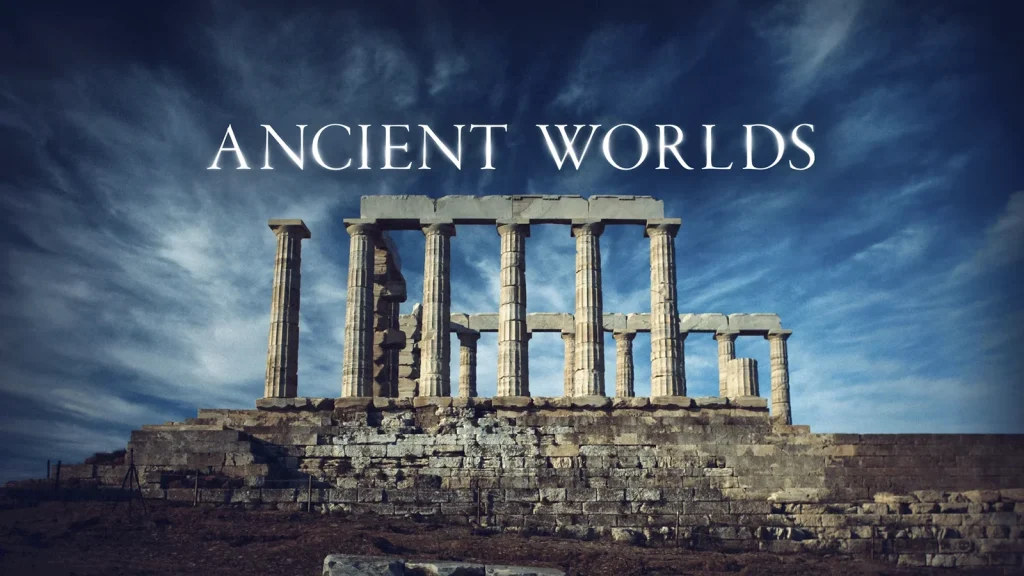
Ancient Worlds – City of Man City of God ep.6
In the final chapter of Ancient Worlds—City of Man, City of God, archaeologist and historian Richard Miles takes us on a gripping journey through the rise and fall of one of history’s greatest empires: Rome. At its peak, the Roman Empire was a vast and formidable force, spanning from the windswept reaches of Hadrian’s Wall in Britain to the sun-scorched banks of the Euphrates River in the East. This colossal empire was home to over 60 million people, all linked together under the powerful banner of Roman rule.
But Rome’s success was not just built on military might or territorial conquests; it was a complex web of cultural aspiration, economic opportunity, and, when needed, military coercion. Even in the face of unstable leadership—under emperors who were, by all accounts, mad, bad, and dangerous—the Roman system stood firm. It wasn’t simply the strength of the legions that held the empire together. No, it was the loyalty of elite families, spread across the far-flung provinces, that provided the glue. These families, despite the distance from Rome, were deeply invested in the empire’s success. They aspired to Roman culture, benefited from its wealth, and understood that defying Rome came with severe consequences.
Yet, for all its might and grandeur, the empire’s internal foundation had cracks that could not be repaired through force or wealth alone. While the Romans excelled at governance and warfare, they lacked a belief system that could answer the more profound questions of existence. The practical, polytheistic religion of Rome—one that worshipped a pantheon of gods tied to everyday life—offered little guidance on deeper spiritual matters. As Rome expanded, its citizens and subjects began to experience the benefits of peace and prosperity, allowing them to shift their attention from survival to contemplation.
It was in this fertile ground that Christianity began to take root. Offering something Rome could not—answers to life’s larger questions—Christianity grew steadily, providing a spiritual framework that appealed to both the common people and, eventually, the highest echelons of power. Its teachings spoke to the deep human need for meaning, salvation, and hope, concepts that the pragmatic Roman gods did not address.
Christianity’s rise coincided with a time of significant change and instability in the Roman world. As internal strife, economic troubles, and external pressures mounted, people sought solace and certainty. The new faith, with its message of eternal life and a just, loving God, offered a compelling alternative to the traditional Roman ways. It wasn’t long before Christianity began to spread like wildfire across the empire, aided by a network of roads and cities that had once been the pride of Rome.
The turning point came with Emperor Constantine. In a bold move that would change the course of history, Constantine embraced Christianity, effectively placing the future of the empire in the hands of this once-persecuted religion. It was a staggering shift. The once invincible City of Man, the pride of Rome, was slowly being eclipsed by the City of God.
Constantine’s conversion not only legitimized Christianity but also marked a deep transformation in Roman society. No longer was Christianity a faith for the fringes; it had become central to the empire’s identity. And with that, Rome’s legacy began to evolve. The imperial city, once a symbol of worldly power and grandeur, now became a place where faith and spirituality held greater sway.
This transformation of Rome—from a mighty empire built on conquest and governance to a civilization that embraced spiritual ideals—illustrates the inevitable shift that every great society undergoes. As the Roman Empire aged, it became less about the physical structures that had once defined it—the roads, aqueducts, and grand monuments—and more about the ideas and beliefs that would shape the future. In many ways, the fall of the Roman Empire wasn’t just about the collapse of a political system; it was about the rise of a new spiritual order that would influence the world for centuries to come.
By the time Rome fell to outside invaders, the seeds of Christianity had already taken root deeply enough to outlast the empire itself. The City of Man had given way to the City of God, and with it, a new chapter in human history began. The Roman Empire’s legacy, though physically diminished, continued in the form of the Christian church, which would go on to shape Western civilization.
Ancient Worlds – City of Man City of God ep.6
In this final episode, Richard Miles doesn’t just examine the nuts and bolts of how Rome fell—he explores the why. The empire’s downfall wasn’t merely due to external invasions or political corruption, though those certainly played their part. It was a spiritual shift, a deeper transformation of values and beliefs, that ultimately signaled the end of the Roman way of life.
The story of Rome is one of ambition, power, and, ultimately, change. As empires rise and fall, so too do the beliefs and systems that hold them together. And in Rome’s case, its greatest legacy may not be its sprawling roads or its monumental architecture, but rather the spiritual foundation it laid for the future.
In the end, City of Man, City of God is not just a tale of a lost empire, but a reminder that even the mightiest of cities must eventually bow to the forces of faith, ideas, and change. And as Richard Miles so expertly shows, it is often in these moments of collapse that new worlds are born.
Part 5 : The Republic of Virtue
How did an insignificant cluster of Latin hill villages on the edge of the civilised world become the greatest empire the world has known? In the fifth programme of the series, archaeologist and historian Richard Miles examines the phenomenon of the Roman Republic, from its fratricidal mythical beginnings, with the legend of Romulus and Remus, to the all too real violence of its end, dragged to destruction by war lords like Pompey the Great and Julius Caesar.
Travelling to Sicily and North Africa, Richard tells the story of Rome’s century-long struggle for dominance with the other great regional power, Carthage. It was a struggle that would end with the total destruction of this formidable enemy and the transformation of landlubber Rome into a seapower, and the Republic into an Empire. But with no-one left to beat, the only enemy that Rome had left was itself.
Part 4 : Return of the King
In Richard Miles’s epic story of civilization, there have been plenty of examples of the great men of history, but none came close to the legend of Alexander of Macedon, known to us as ‘Alexander the Great’. Uniting the fractious Greek city-states, he led them on a crusade against the old enemy, Persia, and in little more than a decade created an empire that stretched from Egypt in the west to Afghanistan in the east.
But it was Alexander’s successors, the Hellenistic Kings, who had to make sense of the legacy of this charismatic adventurer. By knuckling down to the hard graft of politics, taxation and public works, they created something far more enduring than a mere legend – they built a civilization.
Richard traces Alexander’s battle-scarred route through Turkey, Syria and Lebanon to Egypt and ultimately to the western Punjab, Pakistan, where he discovers fascinating traces of a city where Greek west and Buddhist east were united in an intriguing new way.
Part 3 : The Greek Thing
Richard Miles explores the power and the paradox of the ‘Greek Thing’ – a blossoming in art, philosophy and science that went hand in hand with political discord, social injustice and endless war.
He paints a fascinating picture of the Ancient Greece and the internal and external pressures that fuelled this unique political and social experiment, one that would pioneer many of the political systems that we still live with today, from oligarchy to tyranny, from totalitarianism to democracy.
Part 2 : The Age of Iron
Archaeologist and historian Richard Miles looks at the winners, losers and survivors of the great Bronze Age collapse, a regional catastrophe that wiped out the hard-won achievements of civilisation in the eastern Mediterranean about 3,000 years ago. In the new age of iron, civilisation would re-emerge, tempered in the flames of conflict, tougher and more resilient than ever before.
Part 1 : Come Together
Archaeologist and historian Richard Miles explores the roots of one of the most profound innovations in the human story – civilisation – in the first episode of an epic series that runs from the creation of the first cities in Mesopotamia some 6,000 years ago, to the decline and fall of the Roman Empire. Starting in Uruk, the ‘mother of all cities’, in southern Iraq, Richard travels to Syria, Egypt, Anatolia and Greece, tracing the birth and development of technology and culture.
Ancient Worlds is an illuminating and spectacular six-part odyssey tracing the development of Western civilization – from the first cities of Mesopotamia to the fall of the Roman Empire.
Ancient Worlds tells the amazing stories of disappeared, ruined and modern cities – from Ancient Iraq to Augustan Rome, and from Phoenicia and the city states of Greece to today’s Damascus – and reveals the compromise, ruthlessness, sacrifice and toil that made each city work.
In an epic sweep of history against a panorama of stunning locations, Richard Miles, with the help of local experts and archaeologists, brings these legendary civilizations back to life to show how the successes and failures of the ancients shaped the world that we have inherited.
F.A.Q. Ancient Worlds – City of Man City of God ep.6
Q.: What is the focus of City of Man, City of God in Ancient Worlds?
A.: The final episode of Ancient Worlds, titled City of Man, City of God, focuses on the rise and fall of the Roman Empire. It explores the complex forces that maintained Rome’s dominance and the spiritual transformation that led to the empire’s eventual decline.
Q.: How did Christianity influence the Roman Empire?
A.: Christianity filled a spiritual void in the Roman Empire, offering answers to profound questions that the pragmatic Roman polytheistic belief system could not. As it grew in influence, it became central to the empire’s identity, especially after Emperor Constantine’s conversion, which marked a significant societal shift.
Q.: What factors contributed to the stability of the Roman Empire despite unstable leadership?
A.: Rome’s stability, even under volatile emperors, was maintained by the loyalty of elite families throughout the empire. These families were tied to Roman culture through economic opportunities, cultural aspirations, and military enforcement, ensuring their continued support.
Q.: What role did the Roman Empire’s infrastructure play in the spread of Christianity?
A.: The Roman Empire’s vast network of roads and cities, originally built for military and administrative purposes, facilitated the rapid spread of Christianity. This infrastructure allowed the new faith to reach diverse regions and communities across the empire.
Q.: How does City of Man, City of God portray the fall of Rome?
A.: The episode portrays Rome’s fall not just as a political or military collapse but as a deeper spiritual transformation. It emphasizes the shift from the material dominance of the Roman Empire, symbolized by the City of Man, to the growing influence of Christianity, referred to as the City of God.