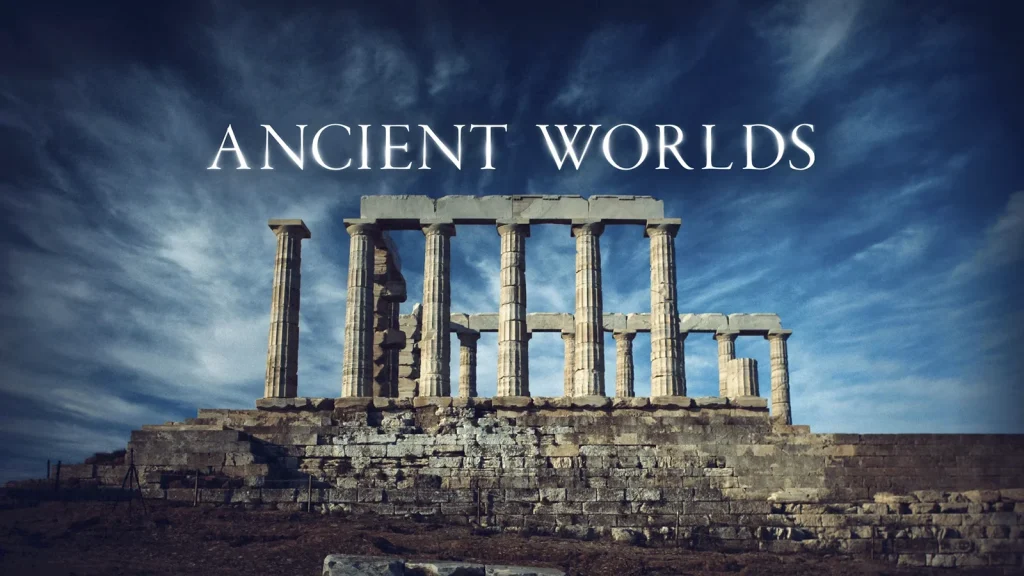
Ancient Worlds – The Republic of Virtue ep.5: How did a small collection of Latin hill villages, nestled at the fringes of the civilized world, transform into the greatest empire history has ever known? In the fifth episode of Ancient Worlds, archaeologist and historian Richard Miles takes us on a journey through the captivating rise and turbulent fall of the Roman Republic. From the mythical and brutal tale of Romulus and Remus to the harrowing end at the hands of warlords like Pompey the Great and Julius Caesar, this story unravels the threads of ambition, power, and betrayal that defined the Republic.
Rome’s beginnings were humble, almost unremarkable. It was just one of many settlements scattered across the rugged landscape of central Italy. But legend has it that its founding was anything but ordinary. The story of Romulus and Remus, twin brothers raised by a she-wolf, is soaked in blood and betrayal. Romulus would ultimately slay his brother to claim the future city for himself, establishing a foundation of violence that would echo throughout Rome’s history. This act of fratricide not only gave birth to a city but also foretold the internal strife that would one day tear the Republic apart.
But this wasn’t just a tale of myth and legend. The Roman Republic was forged in the fires of conflict and expansion. And nowhere was this struggle more evident than in Rome’s century-long rivalry with the powerful city of Carthage. To truly understand Rome’s rise, you must follow its footsteps across the Mediterranean, to places like Sicily and North Africa, where its ambitions clashed with those of Carthage in a series of brutal wars known as the Punic Wars.
Carthage, a wealthy and formidable maritime power, was Rome’s greatest rival for control of the region. The wars between these two giants were not just battles over territory, but also over influence, pride, and survival. The Roman-Carthaginian conflict spanned more than a hundred years, during which Rome would evolve from a landlocked city-state into a seafaring power. The final defeat of Carthage, with its capital city razed to the ground and its people sold into slavery, marked a turning point. With Carthage utterly destroyed, Rome had no external rivals left. But this victory came at a cost.
With no enemy to unite against, Rome’s attention turned inward. The Republic, once held together by shared purpose, began to unravel. Internal divisions, power struggles, and corruption seeped into every corner of Roman politics. Men like Pompey the Great and Julius Caesar, initially seen as protectors of the Republic, became symbols of its demise. These larger-than-life figures, each commanding their own armies, engaged in civil wars that bled the Republic dry. The violence and betrayal that had once forged the Republic now consumed it.
Rome’s story is, in many ways, a reflection of human ambition. Like a fire that starts small and grows into an uncontrollable blaze, Rome’s hunger for power and dominance began with local skirmishes and eventually engulfed entire regions. But with every victory came the seeds of future conflict. For a time, the Roman Republic was a shining beacon of political stability, law, and governance. Its military might was unmatched, and its influence stretched across Europe, North Africa, and the Middle East. Yet, for all its achievements, the very traits that made Rome great also laid the groundwork for its eventual downfall.
Traveling back in time with Richard Miles, you can almost feel the tension rising as the Republic teeters on the edge of collapse. He takes us to places like Sicily and North Africa, where Rome’s struggle for supremacy unfolded, giving us a firsthand look at the lands that shaped this ancient power. It’s a story of both triumph and tragedy, where victory came at a cost so high that Rome could no longer bear it. The Punic Wars, especially the Second Punic War, where the great Carthaginian general Hannibal nearly brought Rome to its knees, tested the Republic’s endurance and will.
Yet, even in the face of near defeat, Rome’s resilience was extraordinary. Like an old oak tree weathering storm after storm, the Republic stood tall, drawing strength from its deep-rooted traditions of civic duty and military discipline. But just as an oak can only stand against so many gales before it cracks, Rome too was wearing thin. The civil wars that followed, led by the likes of Caesar and Pompey, were the final gusts that split the Republic in two.
Ancient Worlds – The Republic of Virtue ep.5
Julius Caesar, in particular, represents the complex nature of Rome’s decline. A brilliant general and cunning politician, Caesar’s rise to power was both a product of Rome’s greatness and a signal of its impending doom. His crossing of the Rubicon River, a moment etched in history as the point of no return, was the death knell of the Republic. Rome, once governed by the will of the Senate and the people, was now at the mercy of one man’s ambition. And though Caesar’s assassination was meant to restore the Republic, it only hastened its fall.
As the dust settled after years of civil strife, the Republic was no more. In its place stood the Roman Empire, a vast and powerful entity ruled by emperors instead of elected officials. The transformation from Republic to Empire was complete, but the scars of that change would never fully heal. Rome’s rise to greatness was meteoric, but its fall was equally spectacular, marked by betrayal, civil war, and the erosion of the very values that had made it strong.
In the end, Rome’s greatest enemy was not Carthage, nor any external foe—it was Rome itself. The Republic, once a model of governance and civic virtue, succumbed to the very forces it had unleashed: ambition, greed, and the thirst for power. This is the story that Richard Miles tells, not just of Rome’s rise and fall, but of the timeless human struggle between unity and division, between greatness and self-destruction.
As we look back at the Roman Republic, we see a mirror of our own world, where power and ambition still shape the fate of nations.
Part 4 : Return of the King
In Richard Miles’s epic story of civilization, there have been plenty of examples of the great men of history, but none came close to the legend of Alexander of Macedon, known to us as ‘Alexander the Great’. Uniting the fractious Greek city-states, he led them on a crusade against the old enemy, Persia, and in little more than a decade created an empire that stretched from Egypt in the west to Afghanistan in the east.
But it was Alexander’s successors, the Hellenistic Kings, who had to make sense of the legacy of this charismatic adventurer. By knuckling down to the hard graft of politics, taxation and public works, they created something far more enduring than a mere legend – they built a civilization.
Richard traces Alexander’s battle-scarred route through Turkey, Syria and Lebanon to Egypt and ultimately to the western Punjab, Pakistan, where he discovers fascinating traces of a city where Greek west and Buddhist east were united in an intriguing new way.
Part 3 : The Greek Thing
Richard Miles explores the power and the paradox of the ‘Greek Thing’ – a blossoming in art, philosophy and science that went hand in hand with political discord, social injustice and endless war.
He paints a fascinating picture of the Ancient Greece and the internal and external pressures that fuelled this unique political and social experiment, one that would pioneer many of the political systems that we still live with today, from oligarchy to tyranny, from totalitarianism to democracy.
Part 2 : The Age of Iron
Archaeologist and historian Richard Miles looks at the winners, losers and survivors of the great Bronze Age collapse, a regional catastrophe that wiped out the hard-won achievements of civilisation in the eastern Mediterranean about 3,000 years ago. In the new age of iron, civilisation would re-emerge, tempered in the flames of conflict, tougher and more resilient than ever before.
Part 1 : Come Together
Archaeologist and historian Richard Miles explores the roots of one of the most profound innovations in the human story – civilisation – in the first episode of an epic series that runs from the creation of the first cities in Mesopotamia some 6,000 years ago, to the decline and fall of the Roman Empire. Starting in Uruk, the ‘mother of all cities’, in southern Iraq, Richard travels to Syria, Egypt, Anatolia and Greece, tracing the birth and development of technology and culture.
Ancient Worlds is an illuminating and spectacular six-part odyssey tracing the development of Western civilization – from the first cities of Mesopotamia to the fall of the Roman Empire.
Ancient Worlds tells the amazing stories of disappeared, ruined and modern cities – from Ancient Iraq to Augustan Rome, and from Phoenicia and the city states of Greece to today’s Damascus – and reveals the compromise, ruthlessness, sacrifice and toil that made each city work.
In an epic sweep of history against a panorama of stunning locations, Richard Miles, with the help of local experts and archaeologists, brings these legendary civilizations back to life to show how the successes and failures of the ancients shaped the world that we have inherited.
F.A.Q. Ancient Worlds – The Republic of Virtue ep.5
Q.: What is the main theme of The Republic of Virtue: How Rome Rose from Obscurity to Power?
A.: The main theme of the episode is the rise and fall of the Roman Republic. It explores how a small group of Latin villages grew into the greatest empire in history, driven by ambition, conflict, and eventual internal collapse.
Q.: How does the story of Romulus and Remus relate to Rome’s history?
A.: The myth of Romulus and Remus serves as a symbolic foundation of Rome’s violent and turbulent history. Romulus’ murder of his brother reflects the internal strife and betrayal that later defined the Republic’s political and military struggles.
Q.: What role did the Punic Wars play in Rome’s transformation?
A.: The Punic Wars were crucial in Rome’s transformation from a regional power to a seafaring empire. The wars against Carthage, particularly their destruction, marked the end of external rivals and set the stage for Rome’s expansion across the Mediterranean.
Q.: How did Julius Caesar contribute to the downfall of the Roman Republic?
A.: Julius Caesar’s ambition and military prowess accelerated the Republic’s collapse. His crossing of the Rubicon and the ensuing civil war shifted power from the Senate to individual rulers, ultimately leading to the birth of the Roman Empire.
Q.: What message does the episode convey about human ambition?
A.: The episode highlights that unchecked ambition, while leading to great achievements, can also sow the seeds of destruction. Rome’s hunger for power fueled its rise, but it also led to internal conflict and the eventual fall of the Republic.