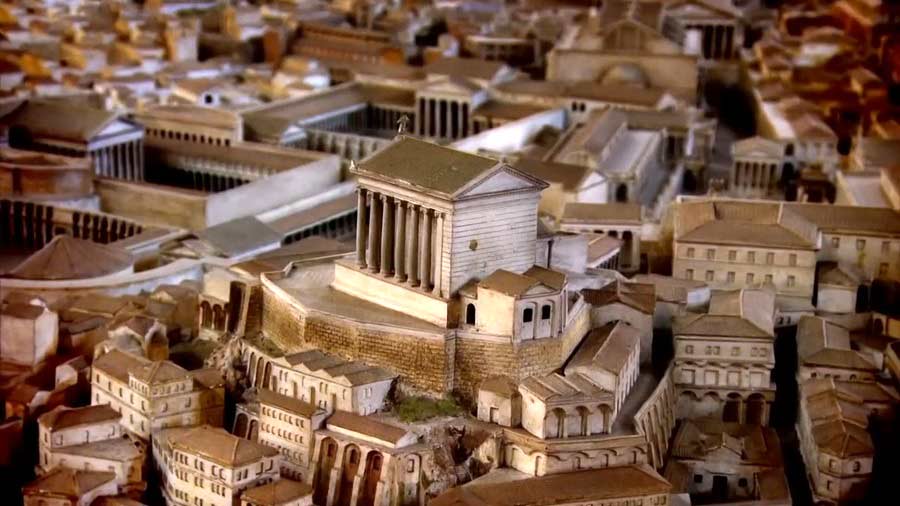
Meet the Romans with Mary Beard episode 2 – Streetlife: Professor Mary Beard discovers the crime and slum conditions in the world’s first high-rise city. In this programme, Mary descends into the city streets to discover the dirt, crime, sex and slum conditions in the world’s first high-rise city. This Rome is not the marble Rome we know, but a vast, messy metropolis with little urban planning, where most Romans lived in high-rise apartment blocks with little space, light, or even sanitation.
Forced outdoors into the city streets, she reveals where they went to hang out, get drunk, have sex and get clean. She looks at the Forum as a place of gamblers, dentists and thieves, and she explores the lustiness of Roman bar life and jokes.
Finally, exploring law and order from the bottom up, Mary examines how this city really worked. She meets Ancarenus Nothus, an apartment dweller who lived in fear of the rent collector; ‘Notorious’ Primus, who wrote about his three great pleasures in life – ‘baths, wine and sex’; and ‘Unlucky’ Doris, a seven-year-old girl killed in one of Rome’s many fires.
We still live in the shadow of ancient Rome – a city at the heart of a vast empire that stretched from Scotland to Afghanistan, dominating the West for over 700 years. Professor Mary Beard puts aside the stories of emperors and armies, guts and gore, to meet the real Romans living at the heart of it all.
In historiography, ancient Rome is Roman civilization from the founding of the Italian city of Rome in the 8th century BC to the collapse of the Western Roman Empire in the 5th century AD, encompassing the Roman Kingdom (753 BC–509 BC), Roman Republic (509 BC–27 BC) and Roman Empire (27 BC–476 AD) until the fall of the western empire.
The civilisation began as an Italic settlement in the Italian Peninsula, traditionally dated to 753 BC, that grew into the city of Rome and which subsequently gave its name to the empire over which it ruled and to the widespread civilisation the empire developed. The Roman Empire expanded to become one of the largest empires in the ancient world, still ruled from the city, with an estimated 50 to 90 million inhabitants (roughly 20% of the world’s population at the time) covering 5.0 million square kilometres at its height in AD 117.
In its many centuries of existence, the Roman state evolved from an elective monarchy to a democratic classical republic and then to an increasingly autocratic semi-elective military dictatorship during the Empire. Through conquest, cultural, and linguistic assimilation, at its height it controlled the North African coast, Egypt, Southern Europe, and most of Western Europe, the Balkans, Crimea and much of the Middle East, including Anatolia, Levant and parts of Mesopotamia and Arabia. It is often grouped into classical antiquity together with ancient Greece, and their similar cultures and societies are known as the Greco-Roman world.
Meet the Romans with Mary Beard episode 2 – Streetlife
In the documentary Meet the Romans with Mary Beard, Streetlife, the familiar image of a majestic, marble-clad Rome is deliberately dismantled. Instead, we descend into a world far more chaotic and recognizable to modern city-dwellers. This was a city of slums, crime, and relentless noise, where ordinary people navigated extraordinary challenges. The grand temples and palaces were merely the backdrop to a much more complex and often grimy reality. This was a city of a million souls, the first great metropolis in history, and its story is written not just in stone monuments but in the forgotten whispers of its everyday inhabitants.
Understanding this version of ancient Rome offers a powerful lens through which to view our own urban existence. Many of the fundamental structures of Western society, from our laws to our architecture, still bear the imprint of the Roman Empire. By exploring the daily life of a common Roman, we uncover the origins of urban anxieties and social dynamics that persist today. The challenges of overcrowding, the need for public services, and the stark divide between the rich and the poor were as present then as they are now. This exploration of history is not about a dead civilization; it is about understanding the foundations of our own.
To truly grasp this perspective, Meet the Romans with Mary Beard, Streetlife moves beyond the grand narratives of emperors and senators. It delves into the world of high-rise apartment blocks, raucous bars, communal toilets, and dangerous back alleys. We learn what it was like to be a child in the city, how one found a doctor, or how families struggled to pay the rent. This is a story pieced together from unconventional evidence: the poignant epitaphs on tombstones, the cheeky graffiti on bar walls, and the archaeological fragments of everyday life that reveal a world both shockingly different and eerily familiar.
The work of historian Mary Beard serves as a guide into this lesser-known past. Ancient Rome was a global city, a melting pot where people and goods came from every corner of the vast empire. This immense concentration of humanity created a unique environment. Our traditional picture of classical order, with its gleaming white columns, is largely a misconception. The reality was a messy, sprawling shanty town as much as it was a seat of power. It was a city of pungent smells, pervasive dirt, and teeming slums, all existing in the shadow of imperial grandeur.
This alternative history is found hidden in plain sight all over the modern city of Rome. Behind the great monuments and emperors in museums are the tombstones of ordinary people, filled with messages for posterity. These inscriptions tell us not just about success, but about the struggles at the bottom of the social ladder. They speak of the constant worries that defined life for so many: finding the next meal, affording the rent, and dealing with illness. These were the grim realities for the vast majority who called Rome home.
One of the most pressing concerns for any Roman was housing. The city was packed with high-rise apartment blocks, known in Latin as insulae, which translates to “islands.” These structures were the ancient world’s skyscrapers, piling people high to accommodate the city’s immense population. Far from being luxurious penthouses, these tenements were often built cheaply, quickly, and poorly. Today, a humble brick building, later converted into a church, offers a rare glimpse into this world. Hidden in the shadow of a grand modern monument, most tourists walk right past it, unaware that it represents the home of the average Roman.
The City of Tower Blocks
Life within an insula was a story of social hierarchy turned vertical. As historian Mary Beard explains, this was “social climbing backwards.” The first floor above the street-level shops might contain a spacious apartment for a reasonably well-off family. These residents enjoyed multiple rooms and some degree of comfort. However, as one ascended higher, the conditions deteriorated dramatically. The upper floors were a labyrinth of dark corridors leading to tiny, cramped rooms, often just a few meters square. Light, space, and fresh air were scarce commodities. These upper-level apartments lacked the most basic services, including running water and sanitation.
To house a million people, the city had to squash them in. It is estimated that a single, small room on an upper floor could have been home to as many as six people. These residents were the city’s working poor. They were day laborers, construction workers on vast public projects, and porters who hauled goods from river barges to warehouses.
For them, these cramped quarters were one step up from sleeping under an aqueduct arch. The tombstone of an ex-slave named Ankarenus Nothus provides a darkly humorous testament to these conditions. In death, he rejoices that he is no longer worried about starving, his feet no longer ache, and he is finally free from the rent collector. For him, the grave offered free board and lodging for eternity.
The residents of these blocks faced a life of constant hardship. A worker returning after a long day of physical labor would find no relief. Their clothes were soaked in sweat, and without running water, they could not bathe. They shared their tiny, smelly space with several other people, be it fellow workers or their own family. Women gave birth in these same cramped conditions. While a few of these high-rise buildings have survived, their full height has not. In their time, these tenements were the tallest residential buildings on the planet, defining the skyline not as a city of marble, but as a city of tower blocks.
Life and Death on the Streets of Ancient Rome
The layout of ancient Rome itself contributed to the chaotic nature of daily life. A precious Roman map carved in stone, a kind of marble A-to-Z, reveals a city that grew organically over time rather than being meticulously planned. The fragments of this map show that Rome was not zoned like modern cities. It was a “rabbit warren” of narrow streets and tiny passageways. Posh houses with private gardens stood directly opposite high-rise tenements and next to workshops, bars, and warehouses. Even the main highways were incredibly narrow, often no wider than the depth of the shops that lined them.
This dense, mixed-use environment created a streetscape full of dangers. Roman writers joked that no one should venture out for an evening stroll without first writing a will. The peril was real; a 13-year-old tourist is known to have been killed by a flying roof tile. The streets were so narrow that one writer claimed he could shake hands with his neighbor across the alley, though he noted he never actually saw or heard the man. This illustrates a key paradox of urban living: extreme physical proximity often coexisted with profound anonymity. Exploring this subject, Meet the Romans with Mary Beard, Streetlife paints a vivid picture of this contradiction.
The dangers went far beyond accidents. The streets were lawless places, especially after dark. The poet Juvenal wrote graphically of dodging violent gangs and drunken bullies while trying to make his way home. A tombstone for a man named Julius Timotheus serves as a Roman cold case file. His wife records that his blameless life was snatched away “by robbers,” who also murdered the seven pupils he had with him. This was not a simple mugging; it was a mass murder.
Yet, there was no official police force to investigate such crimes or provide security for ordinary citizens. The only real security forces were in the pay of the rich. As historian Corey Brennan explains, the ruling elite actively prevented the creation of public services, fearing a rival could gain too much political power by providing them.
Fire was another ever-present threat. The insulae, often rickety and jerry-built with wood, were fire traps. Large parts of the city burned down on numerous occasions. The tombstone of a seven-year-old girl named Doris tells the tragic story of her death in a “sudden fire of incredible violence.” There was no effective public fire brigade.
A paramilitary organization of watchmen, the vigiles, existed, but their equipment was rudimentary: poles to pull down buildings, pails of water, and blankets. They were sometimes brave, but also notoriously corrupt. During the Great Fire of Rome under Emperor Nero, some watchmen allegedly joined in looting the burning buildings instead of fighting the flames. For Doris and countless others, there was likely no one to attempt a rescue.
The People’s Public Spaces
Because homes in ancient Rome lacked what we consider basic necessities, life was overwhelmingly lived outdoors. The high-rise apartments were primarily for sleeping. The city itself functioned as a communal home. The streets were the living room, the public baths served as the bathroom, and local taverns were the kitchen. For ordinary Romans, many activities we now consider private were public affairs. This outdoor existence fostered a unique, communal culture with its own set of rules and social spaces.
Nowhere is this more evident than in the city’s public facilities. According to an ancient guidebook, Rome had 144 public latrines. These were communal toilets where people sat together on long benches, tunics hitched up, chatting as they went about their business. Similarly, the public baths were central hubs of social life, not just places for hygiene. More like a Turkish bath than a modern swimming pool, they featured food stalls, massage booths, and barbers.
The baths were noisy, rough places, full of grunting weightlifters and lurking thieves. One tombstone epitomizes their importance, listing “baths, wine and sex” as the great pleasures that made life worth living. While these spaces could be a great social leveler—in the nude, a poor man with a good physique could feel superior to a wealthy old plutocrat—they also reinforced the social hierarchy, as the rich arrived with an entourage of slaves to clear their path.
Bars and taverns were another essential part of street life. Ranging from seedy dens to more refined wine bars, these establishments served as the dining rooms for the city’s poor, as the rich typically ate at home. The poet Juvenal describes a disreputable clientele of thieves, runaways, and even the local coffin-maker frequenting these places. The elite were deeply suspicious of pub culture, seeing it as a breeding ground for riots and moral decline. Vivid paintings from a bar in Pompeii capture the raucous atmosphere, depicting gambling, drinking, and even a couple having sex on a tightrope. The names of some innkeepers, like “Mr. Hot Sex” and “Madame Gorgeous,” further suggest the colorful nature of these establishments.
Even the Roman Forum, the political and religious heart of the city, was a space for the people. While great speeches and legal cases took place there, it was far from being the exclusive domain of toffs in white togas. The comic writer Plautus provides a satirical “rough guide” to the Forum’s diverse population, pointing out where to find bargain hunters, prostitutes, and rent boys.
Gaming boards are still visible, scratched into the steps of a major law court. Most strikingly, modern archaeology has backed up this vision. An excavation of a shop built into the foundation of a temple uncovered a Roman dentist’s office, complete with 86 extracted human teeth—a grim testament to the agony of ancient dental care. The Forum was as much the people’s place as it was the elite’s.
The Urban Mindset of Ancient Rome
The most fascinating legacy of Roman street life is the mindset it produced. The voices of ordinary people, preserved on their tombstones, offer what Mary Beard calls “tweet-size messages” from the past. These inscriptions tell us who they were, what they did, and what they valued. We meet Sinnio the bodyguard, Hygia the midwife, and a host of others who ask simply to be remembered. These brief epitaphs provide a glimpse into a world of real people with real jobs, stacked up in death just as they were in life in their high-rise burial chambers. This unique aspect of Roman history gives us a direct connection to the populace.
This urban world fostered a sardonic and irreverent sense of humor. In a bar in Ostia, paintings on a latrine wall depict the great sages of ancient Greece offering bawdy advice. The philosopher Chilon, known for the high-minded maxim “desire not the impossible,” is here credited with teaching people how to fart silently. A surviving Roman joke book shows a sense of humor that played on the anxieties of city life.
One joke tells of a man who meets a friend he heard was dead. When the friend insists he is alive, the first man replies, “The man who told me you were dead is much more reliable than you are.” This silly, slightly nasty joke points to a serious problem in a world without formal identification: how do you prove who you are?
Life on the streets of Rome was undeniably tough. It was crowded, dangerous, and lacked the safety nets of a modern city. A tombstone for a woman and a 13-year-old boy reveals they were “crushed by the swarm of a crowd,” a horrifying testament to just how packed the city could get. And yet, there was also a vibrancy and spontaneity to this life that has perhaps been lost in our own sanitized urban environments. As the episode Meet the Romans with Mary Beard, Streetlife suggests, the cheek-by-jowl existence made people live faster, talk faster, and think differently. Despite all the dangers, Rome was an exhilarating, life-affirming place to be.
The Eternal City’s Eternal Lessons: Why Ancient Rome’s Streets Still Matter Today
Walking through any modern metropolis—whether it’s New York, Mumbai, or São Paulo—the ghosts of ancient Rome whisper from every crowded subway car, every overpriced apartment, and every late-night street corner. Mary Beard’s unflinching portrait of Roman street life strips away centuries of romanticized marble to reveal something far more valuable: a mirror reflecting our own urban struggles and triumphs.
The Romans who climbed those rickety insulae each night, dodging flying roof tiles and violent gangs, weren’t so different from today’s city dwellers navigating gentrification, housing crises, and urban crime. They faced the same fundamental challenge we do: how to create meaning, community, and joy in spaces that seem designed to crush the human spirit. Their solution wasn’t to retreat into private bubbles, but to embrace the streets as their extended home. The Forum became their LinkedIn, the public baths their social clubs, and the taverns their living rooms.
This outdoor existence, born from necessity, created something our increasingly isolated digital age has lost: spontaneous human connection. When Ankarenus Nothus celebrated his freedom from rent collectors in death, or when philosophers offered bawdy advice on latrine walls, they were participating in a raw, unfiltered urban culture that valued wit over wealth, survival over status. Their tombstone “tweets” remind us that ordinary people have always been the real protagonists of city life, not the emperors whose statues dominate our history books.
Perhaps most remarkably, these Romans didn’t just endure their chaotic metropolis—they thrived in it. Despite the constant threat of fire, crime, and disease, they developed that distinctly urban superpower: the ability to find humor in hardship, to create community in crowds, and to build resilience through shared experience. Their joke about proving you’re alive speaks to anxieties we still face in our anonymous digital age, while their communal approach to daily life offers a counterpoint to our increasingly privatized existence.
The lesson isn’t that we should return to communal toilets or accept dangerous housing conditions. Instead, it’s that cities have always been humanity’s greatest experiment in cooperation under pressure. Rome’s million inhabitants created the template for urban living that we’re still refining today. Their struggles with overcrowding, inequality, and public services weren’t bugs in the system—they were features of what it means to live together at scale.
As we face our own urban challenges—from climate change to housing affordability to social isolation—Rome’s streets offer both warning and inspiration. They remind us that cities are not just collections of buildings and infrastructure, but living organisms shaped by the daily choices of ordinary people. The Romans turned their constraints into creativity, their proximity into community, and their shared struggles into shared strength.
Next time you’re stuck in traffic, waiting for an overpriced coffee, or navigating a crowded sidewalk, remember: you’re participating in a conversation that began in those narrow Roman alleys 2,000 years ago. The city may have changed, but the essential human drama of urban life continues. We’re all still Romans, making it work one street at a time.
FAQ Meet the Romans with Mary Beard episode 2 – Streetlife
Q: What were insulae and how did Romans live in them?
A: Insulae were ancient Rome’s high-rise apartment blocks, literally meaning “islands.” These structures housed the city’s million inhabitants in cramped, multi-story buildings. The first floor contained spacious apartments for the well-off, while upper floors deteriorated dramatically. Workers often crammed six people into tiny rooms lacking running water, light, and sanitation. Additionally, these tenements were poorly built and frequently collapsed.
Q: How dangerous were Roman streets?
A: Roman streets presented constant hazards to residents and visitors alike. Writers joked that evening strollers should write wills before venturing out. Furthermore, flying roof tiles killed pedestrians, including a documented 13-year-old tourist. Violent gangs and drunken bullies roamed after dark, while robberies occurred frequently. Julius Timotheus and his seven pupils were murdered by robbers, yet no official police force existed to investigate such crimes.
Q: What were public facilities like in ancient Rome?
A: Rome featured 144 public latrines where people sat together on long benches, chatting while conducting business. Public baths served as social hubs with food stalls, massage booths, and barbers. These noisy, rough places attracted grunting weightlifters and lurking thieves. Additionally, taverns functioned as dining rooms for the poor, ranging from seedy dens to refined wine bars with colorful proprietors like “Mr. Hot Sex.”
Q: How did Romans handle sanitation and hygiene?
A: Romans relied heavily on communal public facilities for basic hygiene needs. Most insulae lacked running water and private toilets, forcing residents to use public latrines. The public baths became essential social spaces where people cleaned themselves while conducting business and socializing. However, these facilities were often crowded, noisy, and potentially dangerous. Workers returning from labor couldn’t bathe at home and shared cramped, smelly spaces with multiple people.
Q: What was daily life like for ordinary Romans?
A: Ordinary Romans lived predominantly outdoors since their apartments served mainly for sleeping. The city functioned as their communal home, with streets as living rooms and taverns as kitchens. Workers faced constant hardship, including sweaty clothes, cramped quarters, and fear of rent collectors. Women gave birth in these difficult conditions. Nevertheless, Romans developed resilience and found humor in their struggles, creating a vibrant urban culture.
Q: How was the Roman Forum used by common people?
A: The Roman Forum served as much more than an elite political space. Common people used it for gambling, dental care, and various trades. Gaming boards remain scratched into law court steps, while archaeologists discovered a dentist’s office with 86 extracted teeth. Furthermore, the Forum hosted bargain hunters, prostitutes, and diverse social classes. This accessibility made it truly the people’s space, not just the domain of toga-wearing aristocrats.
Q: What were the main hazards of living in ancient Rome?
A: Fire posed the greatest threat to Roman residents, with entire city sections burning regularly. Seven-year-old Doris died in a “sudden fire of incredible violence,” while inadequate fire brigades used only poles, water pails, and blankets. Additionally, corrupt watchmen sometimes joined looters instead of fighting flames. Overcrowding created another danger, as one tombstone records people being “crushed by the swarm of a crowd.”
A: Roman insulae featured “social climbing backwards,” with wealth decreasing as height increased. Ground-floor shops supported first-floor apartments for reasonably wealthy families with multiple rooms. However, upper floors contained dark corridors leading to tiny spaces housing the working poor. These day laborers, construction workers, and porters lived in conditions barely better than sleeping under aqueduct arches. Ex-slave Ankarenus Nothus celebrated death as freedom from rent collectors.
Q: What can we learn from Roman urban planning?
A: Roman city planning reveals the challenges of organic urban growth without modern zoning. The city resembled a “rabbit warren” with narrow streets and mixed-use development. Posh houses stood directly opposite high-rise tenements, creating a dense, chaotic environment. Additionally, main highways were extremely narrow, often no wider than adjacent shops. This layout contributed to accidents, crime, and the general difficulty of urban navigation.
Q: How does ancient Roman city life compare to modern cities?
A: Ancient Rome’s urban challenges mirror contemporary metropolitan issues remarkably. Housing affordability, overcrowding, and inadequate public services plagued Romans just as they affect modern city dwellers. However, Romans embraced communal living and outdoor existence, creating spontaneous human connections. Their tombstone “tweets” and street humor demonstrate resilience and community spirit. Furthermore, their experience offers both warnings and inspiration for addressing current urban challenges like climate change and social isolation.